
Let's "add AI"
Why every organization wants to embrace AI, and how to do it right

Everyone wants a slice of the AI pie. Whether driven by the promise of increased efficiency, competitive advantage, or simply keeping up the lights, integrating AI into enterprise systems has become a top priority. But beneath the excitement lies a tapestry of expectations, misconceptions, and untapped potentials. Let's dive into the world of enterprise AI and unravel what's real, what's hype, and what's yet to come.
The Perceived Benefits of Enterprise AI
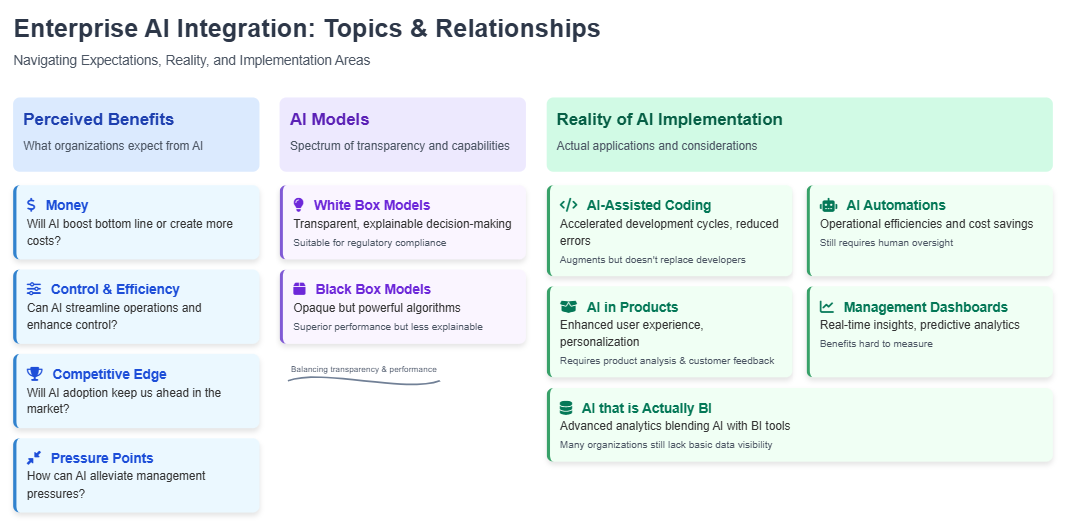
People perceive AI integration as a gateway to financial prowess, operational control, and strategic advantages. They envision:
Money: Will AI truly boost our bottom line, or are the costs outweighing the benefits?
Control and Efficiency: Can AI streamline operations and give us more control over complex processes?
Competitive Edge: Will adopting AI keep us ahead of our competitors in a rapidly evolving market?
Pressure Points: How can AI alleviate management pressures and meet market demands more effectively?
The Reality - what can AI integration really mean?
AI-Assisted Coding
AI-assisted coding promises to accelerate software development cycles by automating repetitive tasks and suggesting optimized solutions. AI-assisted coding will probably be called “coding” soon (or vibe coding as it is called now). It is truly revolutionary.
Real Benefits! - fast development cycles, reduced errors, and enhanced code quality.
Unrealistic Expectations: Can AI truly replace the creativity and problem-solving skills of human programmers? While vibe coding is real and useful, you always need a programmer to manage the workload, verify the AI’s work and so on. It is not meant to replace programmers, but does augment them very effectively.
Management Perspective: Are decision-makers aware of AI's limitations in the creative realm of coding? While it seems that everyone can start vibe coding, it quickly gets out of hand and a senior developer is needed for maintaining complex systems.
AI Automations
Automating routine tasks through AI promises operational efficiencies and cost savings. Yet, the challenge lies in identifying tasks ripe for automation and managing employee expectations.
Tangible Gains: Improved accuracy, reduced operational costs, and faster task completion. The benefits are real!
Myth vs. Reality: Will AI completely eliminate the need for human oversight and intervention? Probably not. But it will make the organization much more efficient.
Management's Take: How do leaders balance automation benefits with the need for human judgment and oversight? This is a critical issue. If everything is automated by AI, we may get real cases of garbage-in-gargage-out. The AI reports will be misleading, the data may be wrong.
Understanding AI Models: From White Boxes to Black Boxes
Machine learning models power AI's decision-making capabilities, ranging from transparent "white box" models to opaque "black box" algorithms. Each type offers distinct advantages and trade-offs.
Transparent Models (white box): Understandable decision-making processes, suitable for regulatory compliance. Better with actual users that need to understand the result and make an action based on it.
Opaque Models (black box): Superior performance in complex tasks but at the cost of explainability. This can be used as part of AI automations.
Expectation Management: Do stakeholders grasp the implications of using black box models in critical decision-making?
AI as Part of Our Software Product: Enhancing User Experience
Software companies always consider “adding AI” to every possible feature. Integrating AI into software products enhances user experience by predicting user behavior, automating responses, and personalizing interactions. It can also increase efficiency of the software by making it faster, more automated, easier to use, etc.
User Expectations: Will AI-driven enhancements delight or overwhelm our user base? This is something to be considered on a case-be-case basis. Proper product sense analysis, benefits analysis, and talking to customers are an inherent part of this analysis.
Product Differentiation: Can AI turn our software into a market leader by offering unique functionalities? Maybe! But if it’s “just AI” it can probably easily be copied.
AI for Management: Dashboards, Insights, and Beyond
AI empowers managers with real-time insights, predictive analytics, and natural language processing capabilities, transforming data into actionable intelligence.
Actionable Insights: How can AI-driven dashboards empower managers to make informed decisions? This is a great promise that is given over-and-over again. But it is rarely possible to measure the effect of “improved decision-making”.
Expectation Alignment: Are leaders prepared for AI's role in transforming managerial practices? If we can wrap it up as something explainable, the odds are much better that AI will transform managerial practices.
User-Friendly Interfaces: Will AI-powered tools simplify complex data analytics for non-technical managers? Another great issue to ponder.
AI that is Actually BI: Bridging the Gap Between Analytics and Intelligence
Unfortunately, many organizations still lack the basic data visibility of BI systems (Business Intelligence) - they don’t even properly implement BI tools like Tableau or PowerBI.
Blurring the lines between business intelligence (BI) and AI, advanced analytics tools leverage AI to uncover hidden patterns, trends, and correlations in data. BI tools are now better and include AI components.
Analytical Depth: How can AI-driven BI tools uncover insights beyond traditional analytics? This is hard to implement and measure.
Integration Challenges: Do we have the expertise to integrate AI seamlessly into our existing BI infrastructure?
Decision Support: Will AI-enhanced BI tools empower decision-makers with actionable insights? As noted above, this is always difficult to measure.
Conclusion: Navigating the AI transformation
Embracing AI is not just technology. Embrace it carefully! As with any business transformation, start with your own real problems that you want to solve, and work backwards from there.